
Looking for better Vimeo video hosting alternatives in 2026? Discover 4 affordable platforms: Waya Stream, Wistia, YouTube, and Vidyard, compared on pricing, security, analytics, and business features.
Video is no longer optional for businesses that want to stay competitive. According to Wyzowl’s 2024 State of Video Marketing Report, 91% of businesses now use video as a core marketing tool, and 87% of video marketers say video has directly increased sales.
From onboarding tutorials and product demos to webinars and executive communications, the platforms businesses choose to host and distribute their video content are increasingly strategic decisions.
Vimeo built a strong reputation as the professional’s alternative to YouTube. For years, it was the default choice for businesses seeking an ad-free player, reliable hosting, and a level of quality the open internet could not match.
In this guide, I have evaluated the four best Vimeo video hosting alternatives for businesses in 2026: WayaStream, Wistia, YouTube, and Vidyard — across pricing, security, analytics, integrations, and the features that matter most to different types of organisations.
Let’s begin
Key Takeaways
- Vimeo video hosting has invested in AI-assisted features, including automatic captions, transcription, smart chapter markers, and clip generation. Its analytics dashboard covers play counts, audience geography, watch time, and device breakdowns.
- Vimeo’s successive pricing updates have made its plans more expensive without a proportional expansion of features
- Waya Stream was designed to handle the full spectrum of business video needs: from protecting premium content and running paid membership communities to launching OTT channels and automating evergreen webinar funnels.
- Wistia supports basic CTAs within the player but lacks the shoppable video, branching scenarios, and interactive funnel features that Waya Stream provides natively.
- Video SEO, in-video lead capture, CRM-connected analytics, and viewer-level engagement data are no longer differentiators; they are baseline expectations for marketing and sales teams using video as a revenue tool.
Vimeo Overview
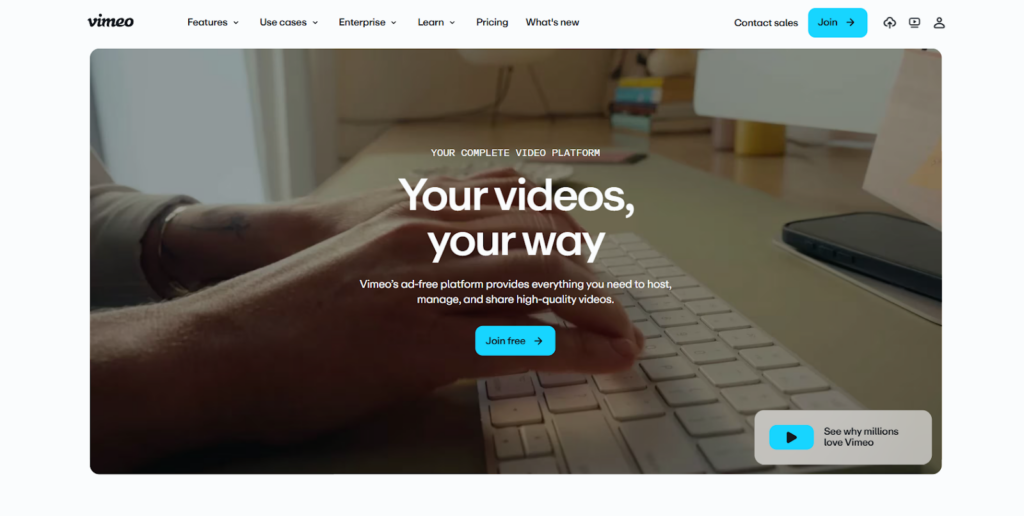
Founded in 2004, Vimeo was among the first platforms to recognise that not every video creator belonged on YouTube. By prioritising quality, aesthetics, and a distraction-free viewing experience, it attracted filmmakers, designers, and agencies who needed a platform that respected their work.
Today, Vimeo reports over 300 million users worldwide, and the platform has evolved significantly, repositioning itself as a B2B video software company rather than a creator community.
That pivot has had mixed results. On one hand, Vimeo now offers a broader suite of business features, including live streaming, analytics, AI captions, and integrations with major productivity tools. On the other hand, the transition has brought higher prices, a restructured plan, and a product that occasionally feels stretched between its creative roots and its enterprise ambitions.
Vimeo’s Core Features for Business
The key Vimeo video hosting features include:
High-Quality Video Playback
Vimeo’s player remains one of the most efficient in the industry. It supports HD and 4K resolution, delivers adaptive bitrate streaming so the viewing experience adjusts smoothly to each viewer’s internet connection, and presents content in a professional, ad-free environment with no competing recommendations or distractions. The player is fully responsive across devices and supports autoplay, loop, and custom embed controls, making it well-suited for use on websites and marketing landing pages where first impressions matter.
Video Management and Organisation
Vimeo video hosting provides a practical video management environment for growing content libraries. Teams can organise videos into folders and project dashboards, bulk-upload files, and update existing videos without changing the embed URL—a genuinely useful feature for refreshing evergreen content without disrupting live links across a website. Team collaboration tools allow admins to assign roles and manage permissions across projects.
Privacy and Access Control
Vimeo’s privacy options cover the standard requirements for most business use cases: public, private, unlisted, and password-protected sharing, along with domain-level embed restrictions that prevent videos from being embedded on unauthorised websites. What the platform notably lacks, however, is DRM (Digital Rights Management) on standard plans and the ability to set link expiration controls, two features that matter significantly for businesses distributing premium or sensitive content.
Customisation and Branding
Businesses using Vimeo video hosting can customize their player’s colour scheme, upload custom thumbnails, add brand logos and watermarks, design end screens with calls to action, and build branded video showcase pages. These tools provide a reasonable level of brand consistency for most use cases. Full white-labelling, removing the Vimeo brand entirely, is, however, restricted to Enterprise subscribers.
Collaboration and Review Tools
Vimeo’s internal review workflow is one of its genuinely standout features. Stakeholders can leave timestamped comments directly on the video timeline, making client feedback and team approval cycles considerably more efficient than email chains. Guest reviewer access eliminates the need for external collaborators to create a Vimeo account, and version history lets teams track changes across successive edits.
AI Features, Analytics, and Integrations
Vimeo video hosting has invested in AI-assisted features, including automatic captions, transcription, smart chapter markers, and clip generation. Its analytics dashboard covers play counts, audience geography, watch time, and device breakdowns. Integrations are available for WordPress, Slack, Zapier, and Google Workspace. However, the platform’s integrations with CRM and marketing automation tools such as HubSpot, Salesforce, and Marketo are notably shallower than those offered by Wistia or Vidyard.
Vimeo Pros
- Ad-free video player with full branding control: Vimeo’s viewing experience is distraction-free and professional, which immediately differentiates it from YouTube for business use. No third-party ads, no competitor recommendations, and a player that can be styled to match your brand.
- Excellent video collaboration and client review tools: The timestamped comment system and guest reviewer access make Vimeo’s review workflow genuinely useful for production teams and agencies. Clients can leave precise feedback without needing an account, and project managers can track approvals without switching tools.
- Strong video quality with 4K support: Adaptive bitrate streaming and 4K playback support ensure a high-quality experience for viewers regardless of connection speed.
- Reliable global CDN and uptime record: Vimeo’s content delivery infrastructure is robust, providing consistent load speeds and reliable uptime for global audiences.
- AI-powered productivity features: Automatic captions, transcriptions, and smart chapters meaningfully reduce the manual effort involved in making video content accessible and navigable.
- Video replacement without URL changes: Updating a video without breaking its embed link is a simple feature, but for teams managing content at scale, it saves significant time and prevents broken embeds across a website or help centre.
Vimeo Cons
- No native DRM or link expiration on standard plans: Without DRM, there is no reliable way to prevent authorized viewers from downloading or redistributing your content. Link expiration controls, which would allow URLs to become invalid after a set time, are also absent from non-enterprise tiers.
- No geo-blocking or IP restrictions below Enterprise: Businesses that need to restrict video access by geography or network are forced onto expensive Enterprise plans. Competitors like Waya Stream include geo-blocking and IP whitelisting on standard business plans.
- Pricing has increased with reduced value alignment: Vimeo’s successive pricing updates have made its plans more expensive without a proportional expansion of features. Many long-standing customers on platforms like G2 and Trustpilot have noted that the value-for-money proposition has weakened compared to earlier pricing structures.
- Not built for course creators or gated content delivery: Vimeo lacks native SCORM support and does not integrate directly with LMS platforms in the way that purpose-built e-learning video hosts do.
- Weaker CRM and marketing automation integrations: While Vimeo connects to HubSpot and Marketo at a basic level, the integrations stop short of passing viewer-level engagement data into contact records or triggering automated CRM workflows, capabilities that Wistia and Vidyard both provide natively.
Vimeo Plans and Pricing in 2026: A Full Breakdown
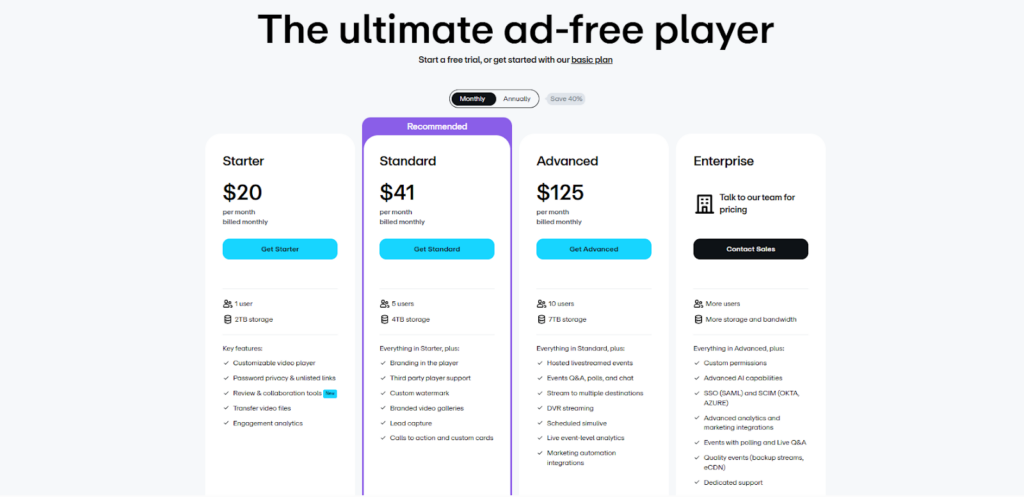
Vimeo’s current pricing structure, based on its official pricing page, is as follows:
Why You Need to Try Vimeo Video Hosting Alternatives
Vimeo remains a capable platform for general business video hosting, but the market has moved.
Today’s alternatives do not just replicate what Vimeo offers; many of them surpass it in specific, high-value areas that matter to businesses in 2026. Here is what is driving organisations to look elsewhere.
The Pricing Gap Has Widened Significantly
The features that most businesses need from a video hosting platform—lead-capture forms, live streaming, advanced analytics, and team collaboration tools —are locked behind Vimeo’s Advanced plan at $125 per month. By contrast, competitors like Vidyard offer a genuinely capable free tier, and Waya Stream bundles enterprise-level features, including DRM and interactive video, at more accessible price points.
Sales and Marketing Teams Require Deeper Integration
Video SEO, in-video lead capture, CRM-connected analytics, and viewer-level engagement data are no longer differentiators; they are baseline expectations for marketing and sales teams using video as a revenue tool. Knowing that a prospect watched 85% of your product demo video and re-watched the pricing section twice is intelligence that changes how and when a sales representative follows up. Vimeo’s analytics do not provide this.
Enterprise Security Requirements Are Not Fully Met
Organisations in regulated industries, premium content businesses, and enterprises handling sensitive communications have security requirements that Vimeo’s standard plans do not adequately address. The absence of DRM encryption, dynamic watermarking, geo-blocking, IP whitelisting, and ephemeral video controls on non-enterprise plans means that serious content protection requires an Enterprise contract or a different platform altogether.
Interactive and Shoppable Video Is Now a Business Standard
The shift from passive video consumption to interactive video engagement is one of the defining trends in business video for 2026. According to Wyzowl’s interactive video statistics, 47% of businesses plan to invest in interactive video formats in the near term. Clickable product links embedded in video, branching scenarios, in-video quizzes, and guided sales journeys through video funnels.
Course Creators and L&D Teams Need Purpose-Built Solutions
SCORM compliance, xAPI tracking, and native LMS integration are table stakes for businesses running formal training programmes, compliance education, or customer onboarding academies. Vimeo video hosting does not natively support these standards, forcing Learning and Development (L&D) teams into cumbersome workarounds or onto platforms better suited to structured learning delivery.
The OTT and Membership Economy Is Growing
Businesses that want to monetise video through subscriptions, paid channels, or branded OTT apps require infrastructure that Vimeo’s standard plans do not provide. Waya Stream, which includes built-in video paywalls, membership site builders, paid video channels, and Cloud TV playout, is purpose-built for this monetisation model.
Top Vimeo Video Hosting Alternatives You Should Try in 2026
1. Waya Stream — Best Overall Vimeo Alternative
Waya Stream earns the top spot on this list by delivering enterprise-level security, interactive monetisation tools, and a comprehensive content infrastructure, without the enterprise-level complexity that usually comes with those capabilities.
Unlike platforms built around a single use case, Waya Stream was designed to handle the full spectrum of business video needs: from protecting premium content and running paid membership communities to launching OTT channels and automating evergreen webinar funnels.
Waya Stream is a cloud-based video hosting and management platform that was built with content protection as its primary architectural priority. That focus on security does not come at the expense of feature breadth — the platform bundles 8K HDR video delivery, interactive and shoppable video, built-in OTT streaming, automated webinars, a membership site builder, and AI-powered production tools into a single, cohesive environment.
It also supports six languages — English, Spanish, Portuguese, French, Arabic, and Hindi — making it particularly well-suited for organisations with global audiences or multilingual content requirements.
Waya Stream Key Features
8K HDR Video Playback with Adaptive Bitrate Streaming
Waya Stream delivers video at up to 8K HDR resolution, a full step beyond Vimeo’s 4K ceiling — using adaptive bitrate technology that adjusts streaming quality in real time based on each viewer’s connection speed. For businesses publishing high-production-value content, product showcases, or training materials where visual clarity matters, this technical headroom is a meaningful differentiator.
White-Label Video Player
Waya Stream’s player is fully customisable, with no third-party branding, providing businesses with a polished, professional viewing experience across all devices. Critically, white-labelling is available on standard business plans, not gated behind an Enterprise tier as Vimeo’s equivalent feature is. This makes branded video delivery accessible for smaller teams and agencies without enterprise budgets.
Video Paywalls and Monetisation Tools
One of Waya Stream’s most distinctive capabilities is its built-in content monetisation infrastructure. Businesses can gate video content behind payments, subscriptions, or membership tiers without relying on third-party tools. This is particularly valuable for media companies, course creators, and professional communities seeking to generate recurring revenue directly from their video libraries.
Membership Site Builder
Waya Stream includes a fully branded membership hub builder, allowing organisations to create subscriber portals where members can access gated content libraries, community features, and exclusive video collections. This collapses the typical tech stack of a content membership business, which might otherwise require a separate platform like MemberSpace, Kajabi, or Memberful, into a single environment.
Simulated Livestreams and Multistreaming
Waya Stream allows pre-recorded videos to be scheduled and broadcast as simulated live events — a powerful tool for businesses that want the engagement benefits of live video without the operational complexity of real-time production. Multistreaming extends reach by broadcasting simultaneously to platforms such as YouTube, Facebook, and LinkedIn, maximising audience coverage from a single broadcast.
Automated Webinars and Workshop Funnels
Waya Stream’s automated webinar functionality enables businesses to build evergreen webinar funnels that run continuously without requiring a live presenter. For companies that use webinars as a primary demand-generation channel, this dramatically improves the format’s efficiency by converting a single live event into a perpetual lead-generation asset.
Shoppable Videos
Waya Stream enables businesses to embed clickable product links directly within the video player, allowing viewers to browse and purchase products without leaving the video. For e-commerce brands and product-led businesses, this turns video content from a passive awareness tool into an active sales channel.
Video Funnels
The platform’s video funnel builder enables businesses to structure content journeys that guide viewers from awareness through conversion, building a cohesive sales or educational narrative from video content, with analytics tracking progress at each stage.
AI Video Chapters, Summaries, and Subtitle Translation
Waya Stream generates AI-powered chapter markers and concise summaries for long-form content, making it significantly easier for viewers to navigate dense material. Its AI subtitle translation and dubbing tool instantly converts content into multiple languages, removing barriers for international audiences without the cost and turnaround time of manual translation.
Built-in Screen and Camera Recorder
Waya Stream includes integrated recording tools for capturing tutorials, demos, and presentations directly inside the platform. This eliminates the need for external recording software such as Loom or OBS for straightforward capture tasks, streamlining the content production workflow for internal teams.
Online Video Editor
The platform’s built-in online video editor allows teams to trim, edit, and refine content without leaving Waya Stream or switching to a separate editing tool. For teams producing a steady flow of training content, marketing videos, or internal communications, this reduces context-switching and shortens time to publish.
Automatic Video SEO
Waya Stream automatically generates meta tags, transcripts, and structured data for hosted videos, improving search engine discoverability without requiring manual SEO effort from the content team. This is directly relevant to the Video SEO entity gap identified in the competitive landscape, a capability that most Vimeo competitors address explicitly.
Cloud TV Playout and OTT Streaming
For organisations ready to move beyond traditional video hosting into broadcast-quality distribution, Waya Stream enables the launch of branded online TV channels and OTT apps accessible on smart TVs, mobile devices, and the web.
Teleprompter
A built-in teleprompter tool helps on-camera presenters deliver polished, confident takes without memorising scripts. For businesses producing executive communications, training content, or customer-facing video at scale, this small addition meaningfully improves the consistency and quality of recorded content.
Waya Stream Security Capabilities
Waya Stream’s security architecture is arguably its most important differentiator from Vimeo video hosting and most other platforms on this list. It addresses all major content protection requirements for businesses in regulated industries, premium content businesses, and enterprise security teams. This includes multi-layer DRM encryption, dynamic video watermarking, IP address whitelisting, domain restrictions, SSO Integration, geo-blocking, ephemeral videos, and URL token signing.
Waya Stream Pros
- Enterprise security without enterprise pricing: Multi-layer DRM, dynamic watermarking, geo-blocking, IP whitelisting, and ephemeral video controls are included on standard business plans.
- Unmatched monetisation options: Video paywalls, membership site builder, paid channels, and OTT streaming are native features, not add-ons, making Waya Stream the most complete platform for businesses building revenue around video content.
- 8K HDR video quality: The highest native video resolution of any platform on this list, with adaptive bitrate delivery ensuring the best possible playback quality for every viewer.
- Interactive and shoppable video built in: No need for additional tools or plugins to add interactivity — shoppable video and video funnels are core platform features.
- AI-powered content tools: From automatic chapter markers and summaries to AI subtitle translation and dubbing, Waya Stream reduces manual content production effort at every stage of the workflow.
- Multilingual support: Native support for English, Spanish, Portuguese, French, Arabic, and Hindi makes Waya Stream a natural choice for organisations with global or multilingual audiences.
- Built-in production tools: Screen recorder, camera recorder, online video editor, and teleprompter eliminate the need for separate production software for most standard content creation tasks.
WayaStream Cons
- Learning curve for new users: The platform’s extensive feature set can feel overwhelming for smaller teams that only need basic video hosting. Getting the most out of Waya Stream’s advanced security and monetisation tools requires meaningful onboarding time.
Waya Stream Pricing
Waya Stream offers tiered pricing with plans designed to scale from solo creators to enterprise organisations. For the most current pricing details, visit WayaStream’s official website. Waya Stream delivers significantly more capability for businesses operating at the intersection of video security and video monetisation.
Why I Recommend WayaStream as a Top Vimeo Alternative
No other platform on this list addresses as many of the gaps in Vimeo’s offering as Waya Stream does, and it does so without requiring an enterprise contract to access the features that matter most.
If your business distributes premium content, runs training programmes, wants to build a membership or OTT business, or needs video security that goes beyond password protection, Waya Stream is the most complete single-platform solution available in 2026.
Its combination of 8K HDR playback, multi-layer DRM, shoppable video, membership site builder, automated webinar funnels, and AI production tools is genuinely unique in the market. For businesses that have been stretching Vimeo to cover use cases it was not built for, WayaStream is the more natural architectural fit.
Vimeo vs. Waya Stream
Here is how Waya Stream compares with Vimeo video hosting across the features that matter most to business users:
| Features | Vimeo | Waya Stream |
| Video Resolution | Up to 4K | Up to 8K HDR |
| Ad-Free Player | Yes | Yes |
| White-label | Enterprise only | Yes (standard plans) |
| DRM Content Protection | No | Yes (multi-layer DRM) |
| Dynamic Watermarking | No | Yes |
| Geo-Blocking | Enterprise only | Yes |
| IP Whitelisting | No | Yes |
| Ephemeral / Expiring Videos | No | Yes |
| Shoppable Video | No | Yes |
| Video Paywalls & Monetisation | No | Yes (built-in) |
| Membership Site Builder | No | Yes |
| OTT / Cloud TV | OTT add-on | Yes (native) |
| Automated Webinars | No | Yes |
| AI Subtitle Translation & Dubbing | No | Yes |
| LMS / SCORM Integration | No | Yes |
| Multistreaming | No | Yes (YouTube, FB, LinkedIn) |
| Multilingual Platform | English primary | 6 languages |
| GDPR Compliance | Yes | Yes |
2. Vimeo vs. Wistia
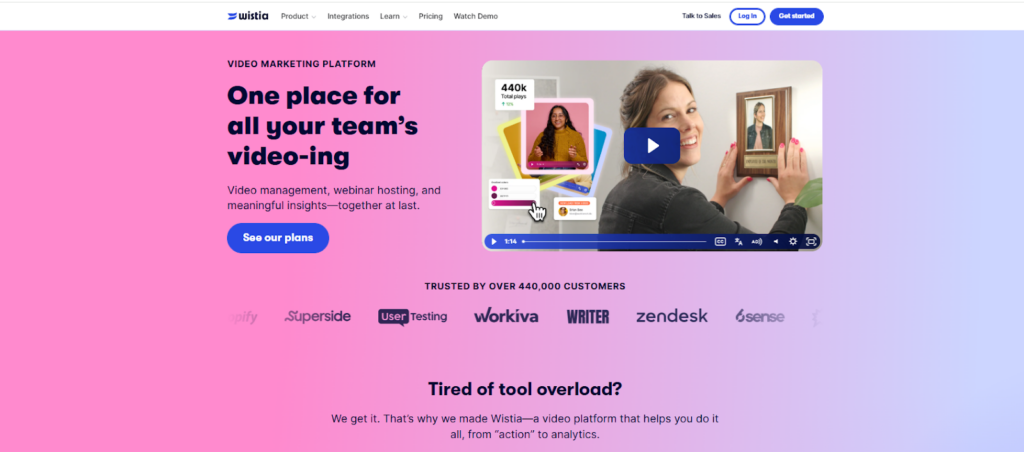
Founded in 2006, Wistia is a purpose-built video marketing platform for B2B companies. Where Vimeo targets a broad audience of creative professionals and businesses, Wistia’s entire product is designed around a single objective: helping marketing and sales teams use video to generate and convert pipelines.
It has earned a devoted following among SaaS companies, growth-stage businesses, and digital agencies that treat video as a measurable marketing channel rather than a content archive.
Wistia Key Features
Marketing-Focused Video Player with Turnstile Lead Capture
Wistia’s player serves as both a marketing tool and a video viewer. The Turnstile feature allows businesses to embed email-capture forms before, during, or at the end of a video, converting viewers into leads without sending them to a separate landing page.
Branded Video Content Hubs
Wistia Channels allows businesses to build Netflix-style, branded video hubs that can be embedded on their own domain or hosted on a Wistia-powered custom URL. These hubs are ideal for thought leadership content series, product education libraries, and customer success video collections, turning scattered video content into a structured, discoverable destination that keeps viewers on your own properties rather than a third-party platform.
Deep HubSpot, Marketo, and Pardot Integration
Wistia’s most commercially valuable capability is the depth of its marketing automation integrations. Viewer engagement data, which contacts watched which videos, for how long, and how many times, flows directly into HubSpot contact records, Marketo leads, or Pardot prospects, where it can trigger automated email sequences, update lead scores, or flag high-intent accounts for immediate sales follow-up. This transforms video from a passive awareness asset into an active pipeline intelligence tool.
A/B Testing for Video Thumbnails
Wistia enables A/B testing on video thumbnails, allowing teams to identify which still frames drive the highest click-through rates on email campaigns, landing pages, and social posts. For businesses running high-volume email programmes, even a modest improvement in video click-through rate compounds meaningfully over time.
Podcast Hosting and Multi-Format Distribution
Wistia expanded its platform to include native podcast hosting, enabling teams to repurpose video content as audio and distribute episodes to Spotify, Apple Podcasts, and other directories directly from within Wistia. This makes the platform a genuine multi-format content marketing tool rather than a pure video host — a relevant consideration for content teams looking to consolidate tooling.
Video SEO Designed to Build Your Own Domain Authority
Unlike YouTube, where SEO value accrues to YouTube’s domain, Wistia is specifically designed to direct video SEO signals back to the host website. Videos hosted on Wistia and embedded on your domain generate structured data, video sitemaps, and rich snippet eligibility that strengthen your own site’s search visibility — not a third party’s. For B2B companies investing in content SEO, this distinction has real long-term value.
Wistia Pros
- Best-in-class marketing automation integration: Wistia’s HubSpot and Marketo connections are the deepest on this list, making it the clear choice for marketing operations teams that need video engagement data inside their CRM.
- Turnstile lead capture on all plans: Converting video viewers into leads without a separate form is a core feature available from Wistia’s entry-level tiers.
- Branded content hub builder: Wistia Channels makes it straightforward to build a professional video destination on your own domain, with results that look genuinely polished.
- Video SEO focused on your domain: Every Wistia video you embed contributes SEO value to your own site, which is a meaningful competitive advantage for content-driven B2B organisations.
- Privacy-first hosting: Wistia does not display third-party advertising, does not retarget your viewers, and is built to keep audience data within your control, a strong position for GDPR-conscious businesses.
- Podcast hosting included: Native audio distribution alongside video is a useful consolidation for content teams managing multiple formats.
Wistia Cons
- No live streaming: Wistia does not support live video broadcasting, meaning businesses that need both hosting and live events must use separate platforms for each.
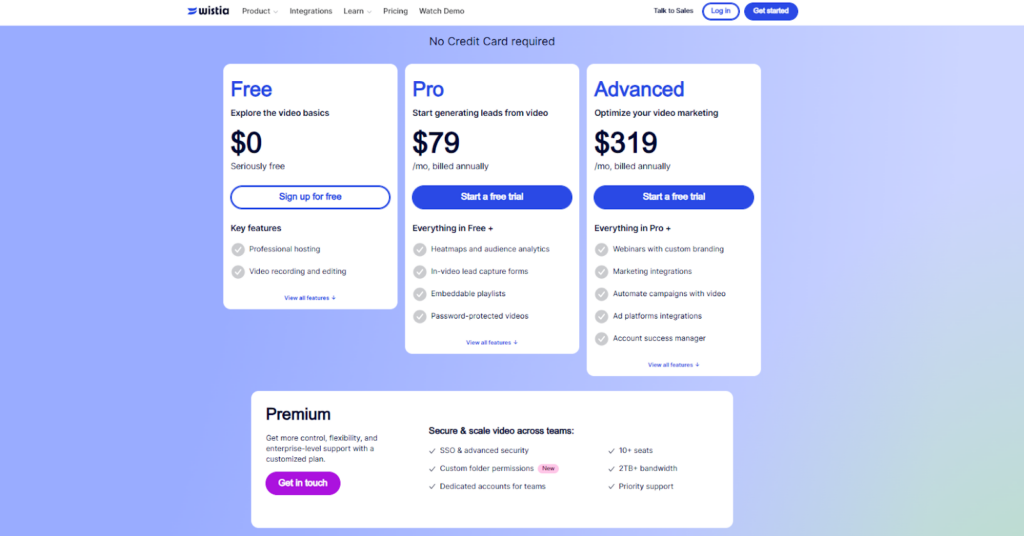
- Advanced plan pricing is steep for smaller teams: At $319 per month for the Advanced tier, Wistia’s full feature set comes at a cost that may be difficult to justify for businesses not yet generating a meaningful video pipeline.
- No DRM content protection: Like Vimeo, Wistia does not offer DRM encryption, which limits its suitability for premium content distribution or enterprise-level content security requirements.
- Not designed for training or internal communications: Wistia’s marketing focus makes it less suitable for L&D teams, internal video communications, or structured course delivery. Teams with those requirements will find WayaStream or Vidyard more appropriate.
- Limited interactive video: Wistia supports basic CTAs within the player but lacks the shoppable video, branching scenarios, and interactive funnel features that Waya Stream provides natively.
Wistia Pricing
Based on Wistia’s official pricing page, current plans are:
Why I Recommend Wistia as a Top Vimeo Alternative
If your team primarily uses video as a demand-generation and pipeline-intelligence tool, Wistia is the most purpose-built platform available. The combination of Turnstile lead capture, deep HubSpot integration, A/B thumbnail testing, and viewer-level engagement reporting creates a video marketing engine that Vimeo video hosting cannot match at any price.
For a SaaS marketing team, a digital agency, or a B2B company running content-driven demand generation, the measurable impact on pipeline visibility and conversion rates that Wistia enables justifies the investment. Just be aware that if live streaming, DRM, or LMS integration are on your requirements list, you will need to complement Wistia with another tool.
Vimeo vs. Wistia
Here is how Wistia’s platform compares with Vimeo:
| Features | Vimeo | Wistia |
| Starting Price (Paid) | $20 / month | $79 / month |
| Ad-Free Player | Yes | Yes |
| White-label | Enterprise only | Yes (Pro and above) |
| In-Video Lead Capture | Advanced plan only | Yes (Turnstile, all plans) |
| HubSpot Integration | Basic | Deep, native integration |
| Salesforce Integration | Basic | Advanced plan |
| Marketo / Pardot | No | Yes (Advanced plan) |
| Video A/B Testing | No | Yes (thumbnails) |
| Live Streaming | Yes (Advanced plan) | No |
| Podcast Hosting | No | Yes (native) |
| Video SEO (own domain) | Partial | Yes (core focus) |
| DRM Protection | No | No |
| Branded Content Hub | Vimeo Showcase | Wistia Channels (stronger) |
| GDPR Compliance | Yes | Yes |
3. Vimeo vs. YouTube
YouTube is the world’s largest video platform and the second-largest search engine on the internet, owned by Google since 2006. With over 2.7 billion logged-in monthly users as of 2024, YouTube occupies a unique position in the video hosting landscape: it is both an infrastructure platform and a global discovery engine.
For businesses that want their video content found by people who have never heard of them, YouTube offers a distribution advantage that no other platform in this guide can match.
However, YouTube’s strengths come with real trade-offs, and businesses that evaluate it solely on reach without accounting for its limitations around advertising, branding control, and analytics depth often end up needing a complementary private hosting platform alongside it.
YouTube Key Features
Organic Reach and Discovery
A product tutorial, explainer video, or thought leadership piece that ranks well on YouTube can generate organic views for years without additional promotion spend. For businesses investing in content marketing, YouTube’s perpetual distribution flywheel is its most compelling selling point compared with any private hosting platform.
YouTube Studio Analytics
YouTube Studio provides a reasonably comprehensive analytics dashboard covering watch time, audience demographics, traffic source breakdowns, subscriber trends, click-through rates on thumbnails, and revenue reporting for monetized channels. While it lacks the viewer-level CRM integration offered by Wistia and Vidyard, it is more than sufficient for businesses focused on building an audience and measuring content performance at the aggregate level.
Free Live Streaming at Scale
YouTube provides free live streaming with the capacity to support millions of concurrent viewers, a level of scale that Vimeo only unlocks at its $125/month Advanced plan. For businesses running product launches, town halls, industry events, or large-scale webinars, this cost differential is significant.
YouTube Shorts and Multi-Format Content
YouTube’s native support for Shorts, vertical short-form video content of 60 seconds or less, gives businesses a single platform for both long-form and short-form video strategies. Rather than maintaining separate presences on TikTok and Instagram Reels, teams can consolidate short-form content on YouTube while benefiting from cross-promotion between Shorts and long-form audiences.
Google Integration and SEO Reach
YouTube videos frequently appear in Google search results, both in standard organic listings and in dedicated video carousels. For businesses optimising for search visibility, a strong YouTube presence extends SEO reach beyond traditional text-based content into the growing share of search real estate occupied by video results.
YouTube Pros
- Completely free at unlimited scale: No storage caps, no bandwidth costs, no monthly subscription fees. YouTube is the most cost-effective hosting option available for businesses where reach and discoverability are the primary objectives.
- Organic discovery: No other video platform provides comparable inbound traffic potential through search rankings and algorithmic recommendations.
- Free live streaming for large audiences: Broadcasting to millions simultaneously, at no cost is a capability that every other platform on this list either charges a premium for or does not offer at all.
- Google search integration: YouTube videos rank in Google search results, extending content visibility beyond YouTube itself into the world’s largest search engine.
- Universal audience familiarity: The friction of directing an audience to YouTube is effectively zero. Almost everyone is already there.
YouTube Cons
- Advertisements on your content: Competitor ads can appear before, during, and after your business videos unless viewers have YouTube Premium. You have no control over which ads run against your content, which means a competitor’s product advertisement may play immediately before your own product demo.
- Limited branding control: The YouTube interface, logo, and platform identity are prominent in the embed experience and cannot be removed on standard accounts. Presenting a fully brand-consistent, professional viewing environment is not feasible on YouTube.
- Competitor video recommendations at the end of your content: YouTube’s algorithm recommends other videos — often from your competitors at the end of every video you publish. For businesses using video as a conversion tool, this is a significant problem: you spend money producing content that drives engaged viewers to your competitors.
- No lead capture or CRM integration: YouTube provides no mechanism to capture viewer information or pass engagement data into a CRM. From a sales intelligence standpoint, it is a black box that generates awareness but not pipeline data.
- Limited privacy and access control: While YouTube supports unlisted and private videos, it does not offer domain-level embed restrictions, password protection with the flexibility of Vimeo, or the enterprise access controls available on specialised platforms.
YouTube Pricing
YouTube is free for businesses to upload, host, and stream content without limits. YouTube Premium ($13.99/month per individual viewer) removes ads from the viewer’s experience, but this is a consumer subscription that the channel owner cannot enforce or subsidise for their audience. YouTube Select and channel memberships are monetisation products, not hosting plans, and are not directly relevant to the business video hosting comparison.
Why I Recommend YouTube as a Top Vimeo Alternative
YouTube deserves a place on this list specifically for businesses whose primary video objective is organic reach, search visibility, and audience growth. If your content marketing strategy depends on being found by people who do not yet know your brand, YouTube is incomparably more effective than any private hosting platform.
A well-optimised tutorial, case study, or thought leadership series on YouTube will generate organic traffic that a Vimeo or Wistia-hosted equivalent cannot match.
The important caveat is that YouTube is most powerful when used alongside a private hosting platform rather than as a replacement for one. For content where you need branding control, lead capture, viewer analytics, or content security, YouTube falls short, but for top-of-funnel content designed to attract new audiences at minimal cost, it remains unbeatable.
Vimeo vs. YouTube
Here is a direct comparison of Vimeo video hosting and YouTube on the dimensions most relevant to business users:
| Features | Vimeo | YouTube |
| Starting Price | From $20 / month | Free (unlimited) |
| Ad-Free Experience | Yes | No (on free accounts)No (on free accounts) |
| Custom Branding | Yes | Limited Limited |
| Organic Discovery | No (private platform) | Yes (massive scale) |
| Google Search Integration | No | Yes (native) |
| In-Video Lead Capture | Advanced plan only | NoNo |
| CRM Integration | Basic | NoneNone |
| Privacy Controls | Strong | BasicBasic |
| Live Streaming | Advanced plan ($125/mo) | YesYes (free) |
| Competitor Recommendations | No | Yes (always) |
| Storage Limits | Plan-dependent | Unlimited Unlimited |
| DRM Protection | No | NoNo |
| White-label | Enterprise only | NoNo |
4. Vimeo vs. Vidyard
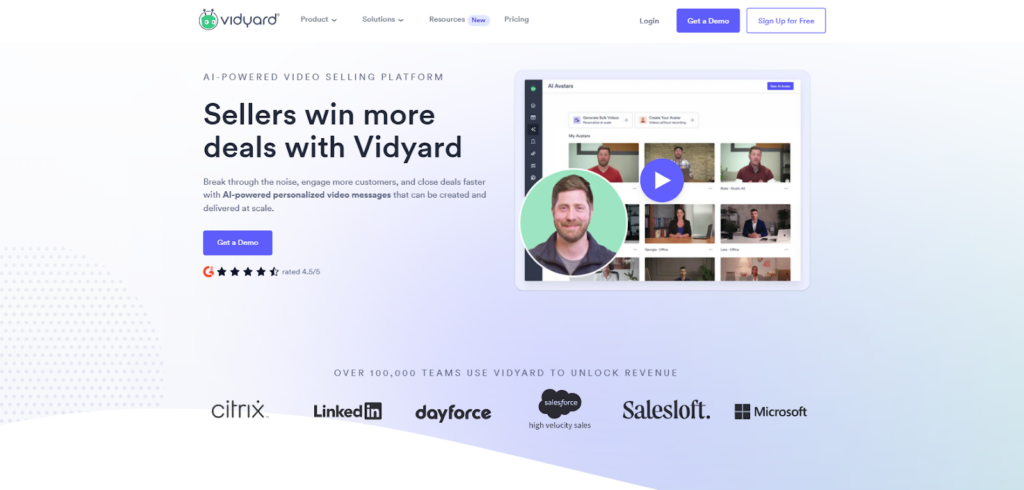
Founded in 2011 and headquartered in Kitchener, Ontario, Vidyard is a video platform built from the ground up for B2B sales and revenue teams. With over 250,000 businesses using the platform globally as of 2024,
Vidyard has established itself as the definitive tool for sales representatives who want to use video to break through crowded inboxes, build genuine relationships with prospects, and accelerate deal cycles. While Vimeo is a general-purpose video host that sales teams sometimes use, Vidyard is a sales tool that includes video hosting.
Vidyard Key Features
Personalised Video Prospecting
Vidyard’s most influential feature is the ability to create and send personalised, one-to-one video messages for sales outreach. A sales representative can record a short screen and camera video, personalise it by dynamically embedding the prospect’s name in the thumbnail, and send it via email or LinkedIn in minutes.
Native CRM and Sales Platform Integration
Vidyard integrates directly with HubSpot, Salesforce, Outreach, Salesloft, and Gmail, enabling sales representatives to record and send videos without leaving the tools they already use. Viewer engagement data; who watched, for how long, and whether they rewatched key section, is automatically logged as activity within the CRM.
Viewer-Level Video Analytics for Sales Prioritisation
Vidyard’s analytics are explicitly designed around revenue outcomes rather than content performance metrics. Teams can see exactly which named contacts watched a video, how many times, to what percentage of completion, and at which points they stopped or replayed. A prospect who has watched 90% of a 15-minute product demo three times in 48 hours is, by any reasonable measure, a warm lead worth an immediate follow-up.
AI-Powered Video Creation Tools
Vidyard has invested substantially in AI features to reduce the time and effort required to produce sales video content at scale. These include AI script generation based on prospect context, automated video summaries, AI-powered prospecting tools that generate personalised scripts from a prospect’s LinkedIn profile, and automatic captions and transcriptions.
Video Hosting and Marketing Library
Beyond the sales-specific tooling, Vidyard functions as a full video hosting platform. Marketing teams can manage centralised video libraries, customize player branding, configure privacy settings, and embed content on websites and landing pages with in-video CTA capabilities.
Vidyard Pros
- Best platform for B2B sales video: Vidyard’s depth of sales-specific features, personalised video prospecting, CRM activity logging, pipeline-focused analytics.
- Exceptional free plan: Vidyard’s free plan includes unlimited video recording and hosting with core CRM integrations.
- Powerful AI tools: AI script generation, automated summaries, and LinkedIn-based personalisation tools meaningfully reduce the time required to produce contextual, personalised video content at scale.
- Revenue-focused analytics: Knowing exactly which contacts watched your content, and how deeply they engaged, is intelligence that changes sales behaviour in ways that aggregate analytics cannot.
- Seamless workflow integration: Recording and sharing video from within Gmail, HubSpot, or Salesforce reduces tool-switching friction and drives adoption among sales teams who would otherwise avoid separate platforms.
Vidyard Cons
- Not designed for e-learning or internal communications: Vidyard’s product is optimised for sales outreach and marketing content. Teams with primary requirements for LMS integration, structured course delivery, or company-wide internal video communications will find Waya Stream less appropriate.
- No live streaming: Vidyard does not support live broadcasting, which limits its utility for businesses that need both video hosting and live events from a single platform.
- Limited interactive video capabilities: Compared with Waya Stream’s shoppable video and funnel builder, Vidyard’s interactive video features are less comprehensive for content-driven conversion journeys.
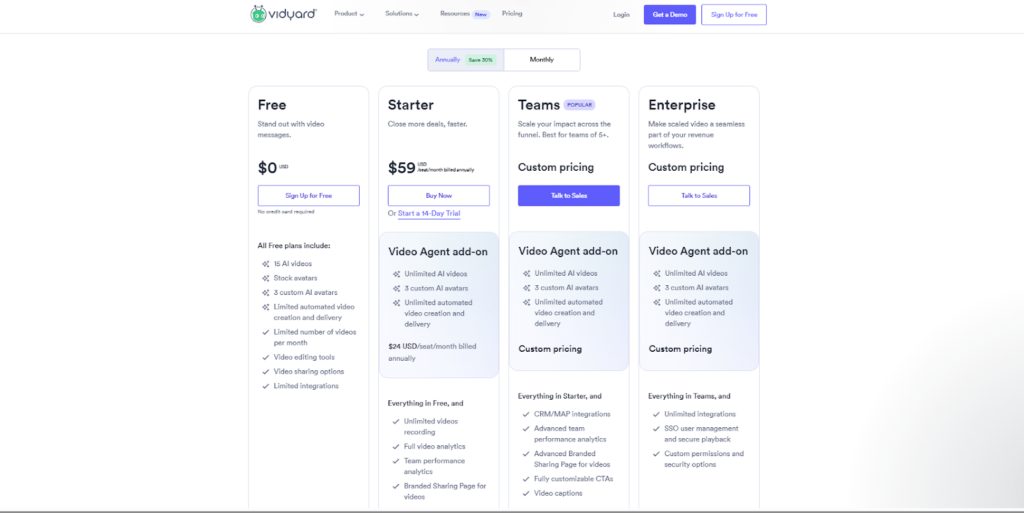
Vidyard Pricing
Based on Vidyard’s official pricing page, current tiers are:
Why I Recommend Vidyard as a Top Vimeo Alternative
Vidyard’s free plan alone is enough to make it worth trying for any B2B sales team. The ability to record a personalised, contextual video, send it directly from HubSpot or Gmail, and then see whether the recipient watched it, and for how long, fundamentally changes the quality of sales follow-up conversations.
A sales representative who knows a prospect and has rewatched the pricing section of a demo three times can open a very different conversation than one working from guesswork.
For organisations that are serious about using video as a sales tool rather than just a content archive, Vidyard provides a measurable competitive advantage that Vimeo’s feature set cannot replicate at any plan tier.
Vimeo vs. Vidyard
Here is a direct comparison of Vimeo video hosting and Vidyard across key features:
| Features | Vimeo | Vidyard |
| Starting Price (Paid) | $20 / month | $59 / month (Starter) |
| Ad-Free Player | Yes | Yes |
| Personalised Sales Video | No | Yes |
| HubSpot Integration | Basic | Deep, native |
| Salesforce Integration | Basic | Yes (Teams and above) |
| Viewer-Level Analytics | Limited | Yes (per contact) |
| AI Script Generation | No | Yes |
| AI Video Summaries | No | Yes |
| In-Video Lead Capture | Advanced plan only | Yes |
| CRM Activity Logging | No | Yes |
| Live Streaming | Advanced plan | No |
| LMS Integration | No | Limited |
| Interactive Video | Limited | Yes |
| DRM Protection | No | No |
Vimeo vs. Top Alternatives at a Glance
The table below gives you a side-by-side reference across all five platforms and the features that matter most to business video users in 2026.
| Features | Vimeo | Waya Stream | Wistia | Vidyard | YouTube |
| Ad-Free Experience | Yes | Yes | Yes | Yes | No (ads on free tier) |
| Password Protection | Yes | Yes | Yes | Yes | Limited |
| Custom Branding & Player | Yes | Yes (fully white-label) | Yes | Yes | Limited |
| In-Video CTAs & Lead Capture | Advanced plan only | Yes (all plans) | Yes (all plans) | Yes | No |
| CRM Integrations | Basic | Yes | Yes (HubSpot, Marketo) | Yes (HubSpot, Salesforce) | No |
| Advanced Video Analytics | Yes | Yes | Yes | Yes (viewer-level) | Basic |
| Live Streaming | Advanced plan | Yes (multistream) | No | No | Yes (free) |
| Free Plan | Yes (very limited) | Yes | Yes | Yes | Yes (Unlimited) |
| AI Captions & Transcription | Yes | Yes (+ AI dubbing) | Yes | Yes | Yes (Auto) |
| DRM / Content Protection | No | Yes (multi-layer DRM) | No | No | No |
| Interactive / Shoppable Video | Limited | Yes (shoppable videos) | Limited | Yes | No |
| LMS / SCORM Integration | No | Yes | No | Limited | No |
| OTT / Cloud TV | OTT add-on | Yes (Built-in) | No | No | No |
| White-label Option | Enterprise only | Yes (standard plans) | Yes (Pro+) | Yes | No |
| GDPR / Data Compliance | Yes | Yes | Yes | Yes | Yes |
Frequently Asked Questions
What video analytics tools does Vimeo provide to measure ROI?
Vimeo video hosting offers engagement analytics covering play counts, impressions, watch time, audience geography, device breakdowns, and, on Advanced plans, more detailed viewer retention heatmaps. However, Vimeo’s analytics do not integrate with CRM systems or pass viewer-level engagement data to marketing automation tools, making it difficult to measure the direct revenue impact of video content.
Does Vimeo support interactive video content for enterprise users?
Vimeo’s interactive video capabilities are limited. The platform supports basic CTAs and chapter markers. Still, it does not natively offer clickable hotspots, branching video scenarios, embedded quiz mechanics, shoppable product links, or the structured interactive funnel experiences that enterprise sales and training teams increasingly require. For a comprehensive, interactive video solution, Waya Stream, which includes shoppable video and video funnel builders as native features, and Vidyard are better-suited alternatives.
What OTT monetisation options are available on Vimeo?
Vimeo offers OTT (Over-The-Top) capabilities through Vimeo OTT (also known as Vimeo On Demand), which enables creators and businesses to set up subscription-based or pay-per-view video services. This is a separate product from the core Vimeo business plans and carries its own pricing and revenue commission structure.
How much does Vimeo cost for businesses in 2026?
Vimeo’s paid plans in 2026 start at $20 per month for Starter, rising to $41 per month for Standard, $125 per month for Advanced, and custom pricing for Enterprise. The key context is that the features most businesses need—live streaming, lead capture, advanced analytics, and API access —are exclusive to the Advanced tier, meaning businesses that need a full feature set are effectively looking at a minimum spend of $125 per month, or $1,500 annually.
Is Vimeo secure enough for confidential or premium business content?
Vimeo provides solid foundational security, password protection, privacy controls, and domain-level embed restrictions, but it falls short of the requirements of premium content businesses and enterprise security teams. The platform does not offer DRM (Digital Rights Management) on standard plans, which means there is no reliable technical barrier to prevent authorised viewers from downloading or redistributing protected content. It also lacks dynamic watermarking, IP whitelisting, geo-blocking on standard plans, and URL token signing.
Does Vimeo allow live streaming for business events and webinars?
Yes, Vimeo supports live streaming, but only with the Advanced plan or higher, which starts at $125 per month. The feature includes live broadcasting, audience Q&A, and automatic recording and replay of live events. For businesses that regularly host live events and require streaming as a core capability, this pricing may be justified.
What is the best Vimeo alternative for businesses that need stronger security?
Waya Stream is the strongest alternative for businesses with serious content protection requirements. Its security feature set includes multi-layer DRM encryption, dynamic viewer-specific watermarking, IP address whitelisting, geo-blocking, SSO integration, domain restrictions, ephemeral video expiry, and URL token signing. This combination addresses every major enterprise content security scenario.
Does Vimeo integrate with CRM and marketing tools like HubSpot or Salesforce?
Vimeo offers connections to HubSpot, Marketo, and Salesforce, but these integrations are relatively shallow. They primarily facilitate embedding and basic analytics tracking, rather than bidirectional data sync that enables marketing automation triggers or viewer-level lead scoring.
Can I white-label Vimeo so viewers do not see the Vimeo brand?
White-labelling is available on Vimeo, but only on the Enterprise plan, which requires a custom pricing conversation and is typically out of reach for small and mid-sized businesses. For organisations that need a fully white-labelled video player at a more accessible price point, Waya Stream includes white-label player customisation on its standard business plans, and Wistia offers white-labelling from its Pro plan.
Final Thoughts on Vimeo Video Hosting Alternatives for Businesses
Vimeo is not a bad platform. It has earned its reputation for good reasons: professional support, a reliable structure, solid collaboration tools, and a genuine commitment to video quality.
For individual creators, small teams, and businesses with straightforward hosting needs, it may still be the right choice. But for the growing majority of businesses that expect more from their video infrastructure in 2026, more security, more monetisation capability, more sales intelligence, more interactivity, the alternatives covered in this guide are not just viable replacements; they are genuine upgrades.
Waya Stream leads this list for good reason. By combining enterprise-grade security, including multi-layer DRM, dynamic watermarking, and ephemeral video controls, with a comprehensive monetisation infrastructure, interactive video tools, OTT distribution, and AI-powered production capabilities.
It addresses more of the gaps in Vimeo’s feature set than any other single platform. For businesses that have been using Vimeo video hosting for use cases it was not designed for, Waya Stream is the most natural migration path.